

CS:APP - Data Lab
Introduction to Computer Systems I (H) @ Fudan University, fall 2019.
实验简介
实验报告
1 bitAnd
题目
x & y using only ~ and |.
1.1 思路
利用 De Morgan's laws 即可。
1.2 解答
1 2 3 4 | |
2 getByte
题目
Extract byte \(n\) from word \(x\). Bytes numbered from \(0\) (LSB) to \(3\) (MSB).
2.1 思路
\(1\ \mathrm{byte} = 8\ \mathrm{bit}\),因此将 \(x\) 右移 \(8n\) 位后,\(x\) 最低的字节就是我们需要提取的 byte \(n\)。之后利用掩码 \(\mathtt{0xFF}\) 提取即可。
2.2 解答
1 2 3 4 | |
3 logicalShift
题目
Shift \(x\) to the right by \(n\), using a logical shift. Can assume that \(0\le n\le 31\).
3.1 思路
负数右移时会在高位补 \(1\),因此需要用掩码提取最低的 \((32-n)\) 位。这里将 \(\mathtt{0x1}\) 左移 \(31\) 位到最高位,然后右移 \((n-1)\) 位得到一个高位 \(n\) 个 \(1\)、低位 \((32-n)\) 个 \(0\) 的二进制数,最后取反即得到我们所需的掩码。
3.2 解答
1 2 3 4 5 6 7 8 | |
4 bitCount
题目
Returns count of number of \(1\)'s in word.
4.1 思路
因为不允许使用循环遍历,这里采用了分治法的思想。1
我们先将这 \(32\) 位数分成左右两组,每组 \(16\) 位;然后将每组 \(16\) 位数再分成左右两组,每组 \(8\) 位数;以此类推,一直细分到每组 \(1\) 位数。
我们知道每组中 \(1\) 的个数 \(=\) 左组 \(1\) 的个数 \(+\) 右组 \(1\) 的个数,因此只要每次将相邻的左组加到右组上,即可得到这组中 \(1\) 的个数。而对于最开始只有 \(1\) 位数的组,其中 \(1\) 的个数就等于这个数本身。
例如:
1 2 3 4 5 | |
在具体实现中,由于常数限定在 \([\mathtt{0x0},\mathtt{0xFF}]\) 的范围,因此做了一些额外处理。
4.2 解答
1 2 3 4 5 6 7 8 9 10 11 12 13 14 15 16 17 18 | |
5 bang
题目
Compute !x without using !.
5.1 思路
只需判断原数是否为 \(0\)。这里将 \(x\) 每次压缩成原来位数的一半,用 \(\mathrm{OR}\) 运算来保留所有的 \(1\)。如果最终得到的 \(1\) 位数为 \(0\) 即表示 \(x = 0\),否则 \(x\ne 0\)。最后取反并利用掩码 \(\mathtt{0x1}\) 提取结果即可。
5.2 解答
1 2 3 4 5 6 7 8 9 | |
6 tmin
题目
Return minimum two's complement integer.
6.1 思路
由二补码的规则易知 \(\mathrm{tmin} = \mathtt{0x80000000}\)。由于常数限定在 \([\mathtt{0x0},\mathtt{0xFF}]\) 的范围,因此采用 0x1 << 31 来表示。
6.2 解答
1 2 3 4 | |
7 fitsBits
题目
Return \(1\) if \(x\) can be represented as an \(n\)-bit, two's complement integer. \((1\le n\le 32)\)
7.1 思路
如果一个非负数 \(x\) 可以表示成 \(n\) 位二补码的形式,那么 \(x\) 最高的 \(1\) 必然不能高于第 \((n-1)\) 位。因此如果对 \(x\) 右移 \((n-1)\) 位所得的结果为 \(0\),即表示 \(x\) 是符合要求的。
为了方便起见,将负数直接取反。如果取反后的 \(\mathrm{NOT}\ x\) 能表示成 \(n\) 位二补码的形式,那么 \(x\) 也同样能表示。这是因为 \(x\) 的范围 \([\mathtt{0x80000000},\mathtt{0xFFFFFFFF}]\) 与 \(\mathrm{NOT}\ x\) 的范围 \([\mathtt{0x00000000},\mathtt{0x7FFFFFFF}]\) 一一对应,而后者正是非负数的范围。
因为不允许使用条件语句,如何将负数取反的同时保持正数不变,这里用了一个 trick,详见代码部分。因为不允许使用减号,这里就用 \(\mathrm{NOT}\ 0\) 来表示 \(-1\) 了。
7.2 解答
1 2 3 4 5 6 7 8 9 10 | |
8 divpwr2
题目
Compute \(x / 2^n\), for \(0\le n\le 30\). Round toward zero.
8.1 思路
非负数直接右移即可;负数直接右移会向下取整,但要求是向 \(0\) 取整(向上取整),因此需要加上一个偏移量。具体处理方式类似于十进制里对进一法的处理,即在原数上先加 \(2^n - 1\),这样即可确保右移 \(n\) 位后的结果是向上取整。
8.2 解答
1 2 3 4 5 6 7 8 9 | |
9 negate
题目
Return \(-x\).
9.1 思路
取反加一即可。
9.2 解答
1 2 3 | |
10 isPositive
题目
Return \(1\) if \(x > 0\), return \(0\) otherwise.
10.1 思路
关键在于对 \(0\) 的处理,直接返回 !(x >> 31) 对于 \(0\) 是错误的。
我们发现:
| 正数 | 负数 | 0 | |
|---|---|---|---|
!(x >> 31) | 1 | 0 | 1 |
!x | 0 | 0 | 1 |
| 期望结果 | 1 | 0 | 0 |
可见这里存在一个 \(\mathrm{XOR}\) 的关系,于是就得到解答。
10.2 解答
1 2 3 4 5 6 7 8 | |
11 isLessOrEqual
题目
If \(x\le y\) then return \(1\), else return \(0\).
11.1 思路
首先判断 \(x\) 和 \(y\) 的符号是否相同,因为如果符号不同,相减可能导致溢出问题,从而得出错误的结果。
如果 \(x\) 和 \(y\) 同号,那么 \(y-x\) 不会导致溢出,我们判断 \(y-x\) 的符号即可。如果 \(y-x\) 为非负数则结果为真,否则为假。
如果 \(x\) 和 \(y\) 异号,那么负数必然小于非负数,我们判断 \(x\) 的符号即可。如果 \(x\) 为负数则结果为真,否则为假。
11.2 解答
1 2 3 4 5 6 7 8 9 | |
12 ilog2
题目
Return \(\lfloor \log_2{x}\rfloor\), where \(x>0\).
12.1 思路
目标是找到 \(x\) 最高的 \(1\) 所在的位置。
因为不允许使用循环遍历,这里采用二分查找1,详见代码部分。
12.2 解答
1 2 3 4 5 6 7 8 9 | |
13 float_neg
题目
Return bit-level equivalent of expression \(-f\) for floating point argument \(f\).
Both the argument and result are passed as unsigned int's, but they are to be interpreted as the bit-level representations of single-precision floating point values.
When argument is \(\mathrm{NaN}\), return argument.
13.1 思路
关键在于判断原数是否为 \(\mathrm{NaN}\),是则直接返回,否则将符号位(最高位)取反后返回。
当 \(f\) 的 exponent bits 全为 \(1\) 且 fraction bits 不全为 \(0\) 时,\(f\) 即为 \(\mathrm{NaN}\)。2
13.2 解答
1 2 3 4 5 6 7 8 9 10 11 12 13 | |
14 float_i2f
题目
Return bit-level equivalent of expression (float) x.
Result is returned as unsigned int, but it is to be interpreted as the bit-level representation of a single-precision floating point values.
14.1 思路
为了方便起见,先将负数转化为其相反数。为此需要将 INT_MIN(\(\mathtt{0x80000000}\))作为特殊情况处理。同时由于整数中只有 \(0\) 是 subnormal number2,因此也作为特殊情况处理。
此后先将 fraction bits 顶到最高位,这样做的好处是之后将有效位数部分截断时,方便判断是否需要进位。
而本题的关键正是这个进位判断。需要注意的是,二进制进位时不是只看被舍去部分的最高位,而是整个被舍去部分(有时也可以只看最高两位)和被保留部分的最低位。在本题中,因为已经将 fraction bits 顶到最高位,因此最低 \(8\) 位就是被舍去的部分(\(32\) 位数中,fraction bits 最多只能有 \(23\) 位)。于是,进位判断的条件为:
- 如果被舍去部分大于 \(\mathtt{0x80}\),则需要进位;
- 如果被舍去部分等于 \(\mathtt{0x80}\),且被保留部分最低位为 \(1\),则需要进位;
- 其余情况不进位。
解决了进位问题后,其余问题都不是问题,详见代码部分。
14.2 解答
1 2 3 4 5 6 7 8 9 10 11 12 13 14 15 16 17 18 19 20 21 22 23 24 25 26 27 28 29 30 31 32 33 34 35 36 | |
15 float_twice
题目
Return bit-level equivalent of expression \(2f\) for floating point argument \(f\).
Both the argument and result are passed as unsigned int's, but they are to be interpreted as the bit-level representation of single-precision floating point values.
When argument is \(\mathrm{NaN}\), return argument.
15.1 思路
只需要处理一些特殊情况即可。
- 当 \(f\) 是 \(\pm 0\) 时,直接返回;
- 当 \(f\) 是 \(\mathrm{NaN}\) 时,直接返回;
- 当 \(f\) 是 subnormal number 时,直接将 fraction bits 左移 \(1\) 位后返回3;
- 其余情况,将 exponent bits 加 \(1\)。
15.2 解答
1 2 3 4 5 6 7 8 9 10 11 | |
运行结果
dlc
1 2 | |
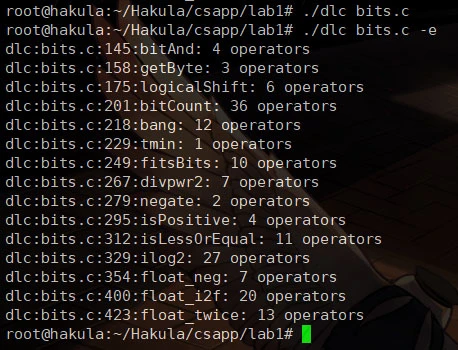
btest
1 | |
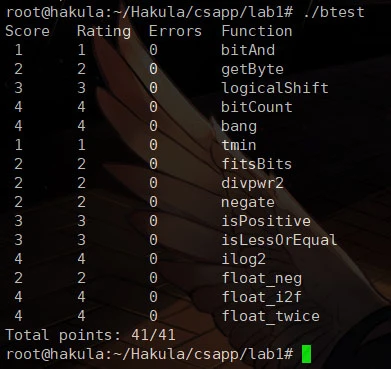
测试环境
- Ubuntu 18.04.3 LTS (GNU/Linux 5.0.0-29-generic x86_64)
- GCC 7.4.0
- GNU Make 4.1
心得体会
有几个题确实难,想了几个小时都想不出来,只好去参考网上的思路。其实从学习效率的角度,感觉毫无头绪的题,在那边硬想也只不过是一种「自我感动」的浪费时间。做这个 Lab 总共耗时 3 天,其中不少时间就是这样无意义地浪费掉了,很不值得。
参考资料
参考了 @codinfox 的思路。
参见 IEEE 二进制浮点数算术标准。
无需担心溢出到 exponent bits 的问题,这是 IEEE 标准所保证的。